
ChatTJB: One Viral Billboard, Two Human Hands
Published on 6 August 2026
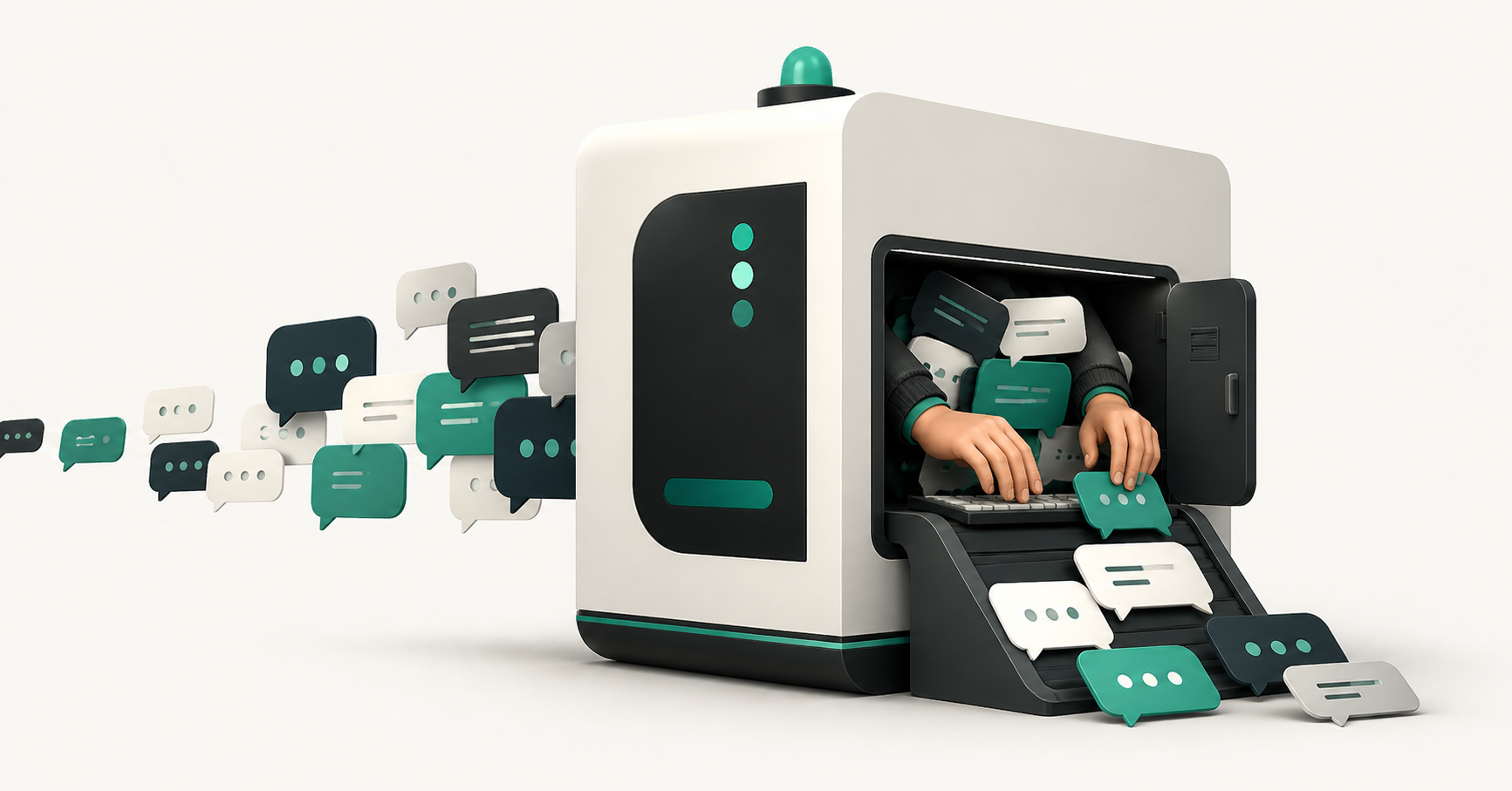
A San Francisco billboard promised “The leading chat interface powered by AI*.” The asterisk was doing most of the product differentiation: AI meant “Average Individual.” Behind the ChatTJB interface, the replies were not generated by an artificial intelligence model. Tucker Bryant wrote them himself, with the standard human allocation of hands.
The project is satire and public art. It also became a compact case study in service capacity: what happens when an idea attracts more requests than one person can answer? The intelligence keeps working; the individual discovers scalability the hard way.
For a small business with two to ten employees, that question has little to do with billboards or chatbots. It is the promotion that suddenly fills a shared inbox, the quote-request form that gets widely shared, the rush of bookings after a popular post, or the client follow-ups piling up while the team is already delivering the work it sold.
The asterisk was funny. The queue was real
Gazetteer SF independently confirmed the creator, the San Francisco billboard and the manually written replies. Separate profiles from Keppler Speakers and Premiere Speakers identify Bryant as a former Google product marketing manager who is now an artist and keynote speaker.
The disclosure is part of the work. ChatTJB's own about page calls it satire and public art that began as a joke. Bryant was not hiding a human under the hood: the human was the concept, the asterisk and, eventually, the bottleneck. That distinction matters. ChatTJB is not evidence that a fully manual service beats automation. It is a human experiment that ran into a volume problem.
In his August 1, 2026 video, Bryant said he was speaking with about 1,000 people a day. The admin screen shown in the video displayed 2,146 answered items and 30 pending at that moment. Those figures come from Bryant and a point-in-time view of his interface; they were not independently measured. The local report describes thousands of daily messages and separately confirms that the overwhelmed project paused on August 3.
The ChatTJB site says incoming demand peaked at 5,000 prompts per hour. That peak is the project's unaudited figure, not an independent count. The same site now warns that replies can take days rather than minutes. At that stated volume, “please wait” stops being a courtesy and becomes service architecture.
That is the useful part of the story. A campaign can fit its promise into six words on a billboard; the team has to keep it one request at a time. The customer-facing promise has to remain compatible with the service capacity behind the screen.
Engagement counters celebrate; the calendar has to work
When checked on August 6, 2026, Bryant's Instagram reel displayed 61.1K likes, 1.9K comments and 3K reposts. Those were platform-displayed counters on a specific date. They change over time, and they are not audited reach, request volume or conversion data.
For a small business, that distinction prevents an easy mistake. Likes are delightful, but not one of them prepares a quote or calls a customer back. A post can draw reactions without producing the same number of customers. A smaller set of well-qualified requests may be enough to fill a calendar. Public engagement does not replace your operating measures: requests received, time to first response, quotes prepared, appointments confirmed and follow-ups still open.
When “Average Individual” needs “Average Organization”
To absorb demand, ChatTJB says it is testing a community-service model. According to the project's site, an approved volunteer “Average Individual” can be assigned to a conversation. The site also says it added onboarding, triage, crisis resources and other safeguards. Their operation and effectiveness have not been independently audited.
That shift from a single responder to multiple people is where the joke meets the org chart. It exposes four questions every small team should settle before a campaign:
Assignment. Who owns each request, and how do you keep it from sitting between two people?
Priority. What needs an answer now, today or this week?
Boundaries. Which requests can use a standard response, and which require human judgment?
The promise. What response time can you state honestly when volume rises?
In your business, the design can be simple. An automatic email confirms that a quote request arrived. A form collects the information an employee needs before pricing the job. A booking tool shows actual availability. A reminder goes out after the meeting. Then a person takes over as soon as an exception, a concern or an important decision appears.
The point is not to remove the human. It is to keep human time from being consumed by acknowledgements, copying information and predictable follow-ups while sensitive conversations wait.
The Pro tier that almost did not want to be purchased
On August 6, 2026, the ChatTJB Pro page listed a $5-per-month tier processed through Stripe. Under the terms stated by the project, it was closer to patronage: the contribution was framed as helping offset the billboard cost and the burden on Bryant's hands while routing prompts directly to him. The site actively discouraged buying it and guaranteed neither a fast reply nor any reply. It was a sales page that politely pointed toward the exit, which is remarkably consistent for a service already receiving too much attention.
That is a snapshot of the terms the site offered on that date. The verified sources disclose no subscriber count, revenue, conversion rate or billboard price. A payment button alone does not show that a campaign is profitable.
Plan for success before launching the campaign
Before your next promotion, run a simple exercise. Imagine the volume of emails, quote requests or bookings exceeding your forecast. Decide in advance what confirmation customers receive, what response time you will state, how requests are prioritized and who owns each exception.
Then automate the repetitive steps around the conversation: receive, classify, confirm, remind and record. Keep a clear path to a person. When capacity changes, tell customers instead of letting silence define their experience.
ChatTJB began as a joke about artificial intelligence. The asterisk earned the attention; the queue delivered the operating lesson. Its most serious contribution for a small business is a question: if your campaign works, is your service ready to keep the promise?